Buying the Past — The Acquisition Risk Nobody’s Diligence Examines
Download as PDF · slide deck (21 slides, PPTX)
Conventional due diligence audits the target company exhaustively and never audits the layer it occupies. This essay argues that value in a technology industry migrates upward through its layers on a schedule, that each layer carries its own diffusion curve, and that the stage of a target’s layer is a material risk factor no workstream owns. AOL–Time Warner is read here as a single transaction with two counterparties on opposite sides of the same judgment, roughly a hundred billion dollars deciding the difference between them. Four later writedowns and one purchase made a decade too early test the pattern; three acquisitions that worked serve as the control group. A four-question test follows, short enough to run before any deal reaches a term sheet and requiring nothing but public data.
I.
Somewhere in the current wave of AI acquisitions, a deal team is closing a diligence file. It runs to hundreds of pages: revenue quality, customer concentration, the technology stack, the litigation exposure, the retention risk in a founding team who are themselves most of the asset. It does not contain the one analysis that would have saved the acquirers of the past twenty-five years something north of a hundred billion dollars.
For a strategist working inside a large technology company at the turn of the century, mergers and acquisitions were not an occasional event. They were weather. Both of the companies where I spent the longest stretches of my corporate career — Ericsson and IBM — acquired on an industrial scale, at their most active absorbing twenty-five or more companies a year, sustained over long stretches, each deal arriving with its own diligence file, integration plan, and quietly optimistic revenue synergy model. My own work sat mostly at the front of that pipeline: industry scanning, mapping the competitive landscape, spotting the candidates worth a closer look before the bankers and the deal teams took over. Years later, at IBM, I found myself at the other end of the same machinery, running workshops built around the company’s acquisitions playbook and introducing its M&A software tooling to other serial acquirers — companies that wanted to buy the way IBM bought, with a documented process for everything from target screening to day-one integration.
That vantage point taught me how much genuine sophistication a serial acquirer brings to auditing a company. The diligence machinery is formidable: the books, the contracts, the customer concentration, the technology stack, the litigation exposure, the revenue quality — every one of these gets a workstream, a checklist, and a specialist. It is also, by the numbers, insufficient: study after study puts the failure rate of mergers and acquisitions somewhere between seventy and ninety percent, and the standard explanations — overpayment, culture clash, botched integration — are all real and all incomplete. Watching deal after deal move through that machinery, I gradually noticed a question that no workstream owned, no checklist contained, and no specialist answered. The question was not whether the target was a good company, but whether the layer of the industry it occupied was still the layer where value was accumulating. The machinery audited the company exhaustively. Nobody audited the layer.
II.
The Premise: Value Moves Through Layers on a Schedule
Value in a technology industry migrates. It moves upward through the industry’s layers — from infrastructure, to access, to applications and services — as each layer in turn commoditizes beneath the one above it. IBM’s mainframe stack looked like permanent infrastructure until the personal computer decoupled hardware from software and value moved to an operating system and a processor architecture IBM did not own. The long-haul fiber built in the late 1990s was real, useful, and essential — and almost a complete write-off for the capital that built it, because bandwidth commoditized on schedule while the value accumulated one layer up, in the applications running across it. Carrier capital-expenditure records show the same arc repeating, generation after generation of network technology, on a cadence regular enough to plan around.
The concept is old. Economists have studied entry, shakeout, and exit in emerging industries for decades, and Steven Klepper’s work on shakeouts is the canonical treatment; every strategist has met the product life cycle. What never arrived in the deal room is its application: the curve that decides an acquisition belongs to the layer, not to the industry and not to the product, and two layers of the same industry can sit at opposite ends of their curves in the same month.
Each layer, in other words, has its own diffusion curve: a rise, a peak, and a long slope into commodity economics. A company can be excellently run and still sit on the wrong part of that curve. Conventional due diligence, built to audit the company rather than the layer, is structurally unable to see it.
III.
The Deal That Shows Both Sides
The clearest case in the historical record is also the largest, and the stage lens explains both sides of the same transaction at once.
In January 2000, America Online announced it would acquire Time Warner in a stock transaction routinely described as the largest merger in American corporate history. The detail that matters, and that popular memory reliably gets backward, is the direction of the transaction. AOL was the acquirer. It used its own stock — paper priced at the absolute peak of the dial-up access layer’s curve — to buy Time Warner’s film studios, television networks, music catalog, and publishing assets, with AOL’s shareholders taking fifty-five percent of the combined company. The internet upstart bought the media empire.
The received account treats the transaction as a single catastrophe. Read through the layer lens, AOL’s side of it was close to strategically perfect. Its management sat on top of the best possible information about the access layer’s actual condition: subscriber growth decelerating, broadband rising underneath the dial-up business, a dominant position about to become a position atop a commoditizing layer. Whether or not anyone inside AOL would have described it in these terms, the substance of the move was exact: convert equity priced at the access layer’s peak into ownership of durable assets one layer up the value chain, before the market reprices the layer underneath. A company cashing out of its own diffusion curve at the top.
Time Warner’s side was the identical judgment with the sign reversed. It accepted payment in a currency whose entire value rested on a layer already at or past its peak, and it accepted at growth-multiple prices, valuing AOL’s position as though the access layer’s future resembled its recent past. The evidence needed to question that assumption was never hidden in AOL’s boardroom. Dial-up subscriber economics and broadband adoption curves sat in the public record, available to any acquirer willing to ask where the counterparty’s layer sat on its own curve. Nobody’s diligence architecture contained the question — and the market broadly shared the blindness, which is what makes the case instructive rather than a story about one company’s unusual foolishness.
The repricing arrived on schedule. For 2002, the combined company reported a net loss of roughly ninety-nine billion dollars — the largest annual loss in American corporate history, then and since — the overwhelming bulk of it goodwill impairment: the accounting system’s delayed, formal acknowledgment that the access-layer value on the balance sheet carried a price the layer no longer justified. Same transaction, two counterparties: one stage-literate in effect if not in vocabulary, one stage-blind, and roughly a hundred billion dollars deciding the difference between them.
IV.
The Pattern, Repeated on Schedule
The same error — paying growth prices for a position in a layer already past its peak — recurs across the largest acquisition writedowns of the following two decades, in deals executed by sophisticated, well-advised acquirers with full diligence processes, none of which contained the layer audit.
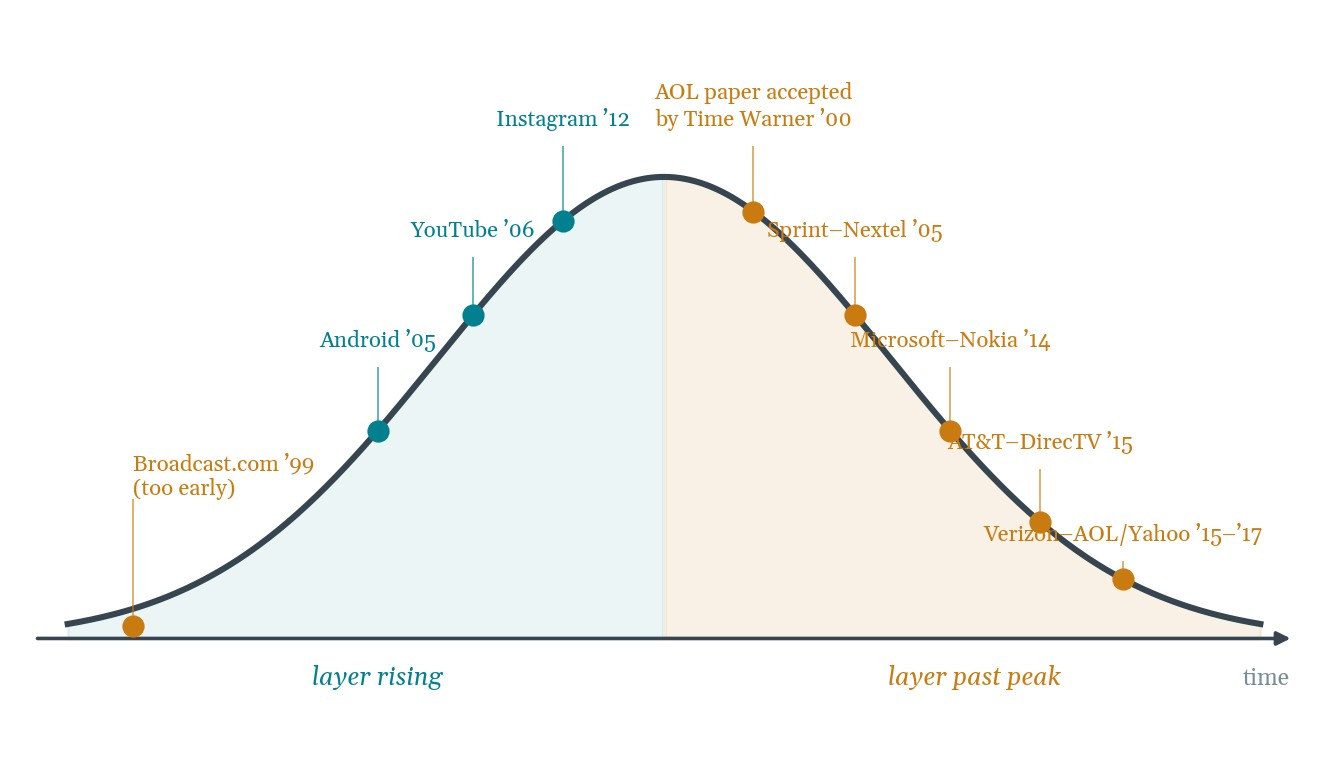
Sprint’s 2005 merger with Nextel, at roughly thirty-five billion dollars, consolidated two positions in a network-access layer heading into commoditization; within thirty months of closing, Sprint wrote down nearly thirty billion dollars of the deal’s value. Microsoft paid roughly seven billion dollars for Nokia’s handset business in 2014, buying a position in device hardware years after value had migrated conclusively to the platform layer above it — a migration Microsoft, of all acquirers, was uniquely positioned to understand, having executed the identical migration against IBM three decades earlier; it wrote the acquisition off nearly in full about fifteen months after the deal closed. AT&T bought DirecTV in 2015 at roughly forty-nine billion dollars in equity value, taking the leading position in linear satellite television at almost precisely the moment streaming began repricing the entire layer; six years later it spun the business out at a valuation on the order of a third of the purchase price. Verizon’s paired acquisitions of AOL and Yahoo, roughly nine billion dollars combined, bought positions in the web-portal and digital-advertising layer after its economics had already concentrated around two platform winners; Verizon wrote the combined business down within eighteen months and sold it to private equity at roughly half what it had paid.
Five deals, five sophisticated acquirers, more than seventy billion dollars in combined value destruction — and in every case, the acquired business was real, operational, and full of competent people. What failed was the assumption, priced into the deal, that the target’s layer still had its growth ahead of it. The layer audit would not have required secret information in any of the five cases. Every relevant marker — capital-expenditure curves, price-decline rates, switching-cost erosion, competitor counts — sat in public data.
The error also runs in the opposite direction. In 1999, Yahoo paid roughly five point seven billion dollars for Broadcast.com, a streaming-media business — the right layer, bought about a decade before the enabling infrastructure existed to carry it. Streaming video was genuinely the future of media distribution; the future in question required broadband penetration, compression, and content economics that 1999 could not supply, and Yahoo quietly shut the acquired business down within three years. Too early and too late are the same diagnostic failure with opposite signs: in both, the acquirer priced the target’s layer without locating it on its own curve.
The success cases are the control group, and they are as instructive as the failures. Google’s acquisitions of Android in 2005 and YouTube in 2006, and Facebook’s 2012 purchase of Instagram, were application-layer purchases made early on that layer’s curve. Each drew charges of overpayment on announcement; each bought a layer whose growth genuinely lay ahead of it. The market’s verdict on price at announcement carries very little information, while the position of the target’s layer on its own curve carries a great deal.
V.
The Objection Worth Taking Seriously
The obvious objection deserves its full weight: this is hindsight dressed as analysis. Every failed deal looks stage-mismatched after it fails; every success looks prescient. Acquisitions fail for well-documented reasons — overpayment, integration collapse, culture clash — and a framework that relabels the same failures with new vocabulary has explained nothing. HP’s acquisition of Autonomy failed catastrophically in a layer nobody would call past peak. Plenty of past-peak purchases, meanwhile, have worked out fine for buyers who wanted the cash flows.
The answer comes in three parts, and the last of them concedes real ground. First, the claim is checkable before the fact rather than merely narratable after it: every stage marker invoked above was public information before each deal was signed, and any reader can run the same test against this decade’s deals as they close. Second, the framework fills all four cells of the grid rather than collecting only its confirmations. It predicts too-early failures as well as too-late ones, from the same curve. It accommodates stage-aligned deals that still fail — HP–Autonomy sits in that cell, destroyed by price and diligence rather than stage, which is precisely the point, since stage alignment is necessary-leaning rather than sufficient. And it accounts for the sparse but real cell of mismatched deals that succeed: buyers who purchase declining layers deliberately, at prices that assume the decline, a playbook private equity has run profitably for decades. That last cell sharpens the claim rather than undermining it. Buying the past is not the error. Paying future prices for it is.
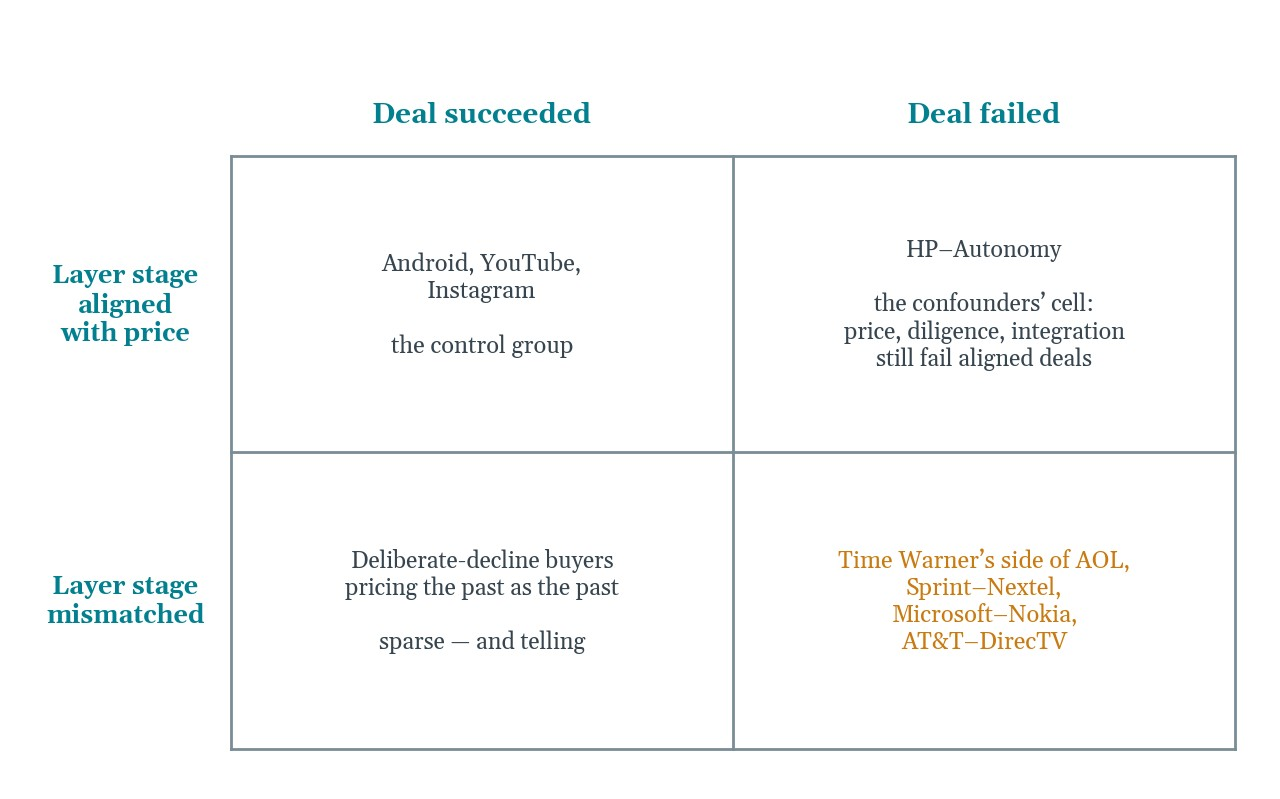
Third, the concession: stage mismatch is not offered as the cause of acquisition failure. Price, integration, and culture remain real, large, and frequently decisive. The claim is narrower and more useful for being narrow: the stage of the target’s layer is a material, independently checkable risk factor that standard diligence does not examine at all — and in several of the largest value destructions on record, it appears to have been the dominant factor hiding in plain sight.
VI.
The Acquisition Test
The diagnostic that falls out of this argument is short enough to run before any deal reaches a term sheet, and it uses only public data.
The first question is locational: where does the target’s layer — not the target — sit on its own diffusion curve? Four markers do the work: where capital expenditure in the layer sits relative to its own history, which direction prices are moving and how steeply, whether customer switching costs in the layer are compounding or eroding, and whether the count of viable full-line competitors is stable or falling. If the diligence team cannot produce this analysis, that absence is itself the finding — the deal is being priced without anyone having located the asset in time.
The second question is the price test: does the valuation assume the layer’s future or its past? A peaked layer may carry years of strong cash flow and remains perfectly buyable, provided the price reflects what it is. Growth multiples applied to a layer whose markers have turned are the precise signature of buying the past at future prices, and that signature was present, checkably, in every failed deal named above.
The third question concerns the counterparty: who is selling, and what do they know about their own layer that the price does not yet reflect? A controlling shareholder converting equity into someone else’s assets at the top of their layer’s curve is information — the AOL side of the 2000 transaction being the historical maximum of the signal. The sharpest version of the question is uncomfortable and worth asking in every deal room: if this layer’s future is as bright as our valuation assumes, why is the party with the best information about it eager to trade it for our assets?
The fourth question is the mirror check, for buyers on the early side: is the enabling infrastructure for this layer actually in place, or is this a Broadcast.com — the right layer, purchased before its curve has begun? The test is whether the layers below the target’s have matured enough to carry it. An application-layer bet made before its access layer exists spends its capital waiting.
VII.
What This Means Now
The question a deal review already asks is whether this is a good company at a defensible price. Substitute a structural one: is this a good company in a layer whose curve still has room, at a price that assumes only the room that remains? The diligence machinery answers the first question superbly. The second belongs to nobody.
The substitution is available on today’s deals, not merely on the archive. The AI wave is producing acquisitions at a cadence that rhymes with 1999 and 2000 — infrastructure, capacity, model companies, whole teams — and every one of them sits somewhere on a layer curve that anyone can locate from public data before the term sheet is signed. Which of those layers is still rising, and which is being bought at growth prices on the way down, is checkable now rather than at the writedown.
For a serial acquirer running a documented playbook, adding the workstream amounts to one more module: a layer audit, owned by someone, required in every deal file, its conclusion stated in writing before the price is set. Set against more than one hundred seventy billion dollars of marked-to-market stage mismatches in the public record, it may be the highest-return diligence workstream available to any acquirer. It is, at present, still almost nobody’s job.
Sources and Notes
Mike Edholm has spent three decades advising corporations and institutions on strategy and scenario planning, with senior roles at Ericsson and IBM — including extended periods inside both companies’ acquisition pipelines — and assignments spanning telecommunications, computing, industrial automation, and international development. This essay draws on his book on technology transitions, currently in preparation.