The Dynamic Markets Model — What Kind of Market Each Stage of a Technology Becomes
Download as PDF · slide deck (9 slides, PPTX)
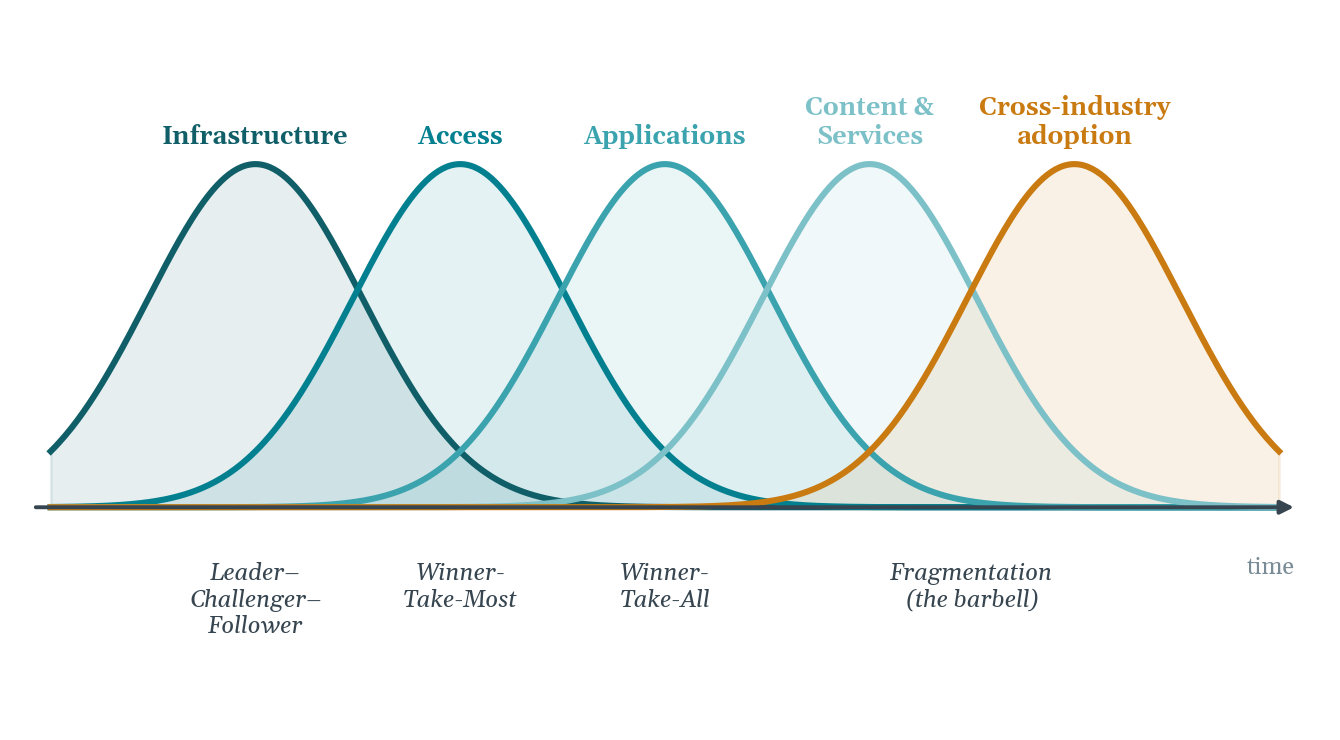
Market structure is usually treated as a fixed property of an industry, settled once by that industry’s particular economics. This essay proposes something different: that market structure is a predictable function of which stage of its diffusion curve a technology currently occupies. As a capability diffuses, it passes through a sequence of stages, from infrastructure to access to applications and on into services and cross-industry absorption, and each stage tends to produce a characteristic market structure. Three recur across technology markets: Leader-Challenger-Follower, where several genuinely viable competitors coexist; Winner-Take-Most, where one player leads clearly but real challengers survive; and Winner-Take-All, where concentration approaches a near-monopoly. The claim is that these structures are not scattered at random across industries. They arrive in the same order, at the same stages, for identifiable economic reasons. The essay tests that claim against three independent cases spanning three decades: the fixed internet, cloud infrastructure, and the smartphone industry. In each, the predicted structure is checked against documented market-share history rather than asserted from theory. The pattern holds with unusual consistency. Where it does not hold cleanly, the exceptions are reported plainly, because a framework that only shows its confirming cases is not one worth trusting.
I.
A puzzle sits underneath most conversations about technology market structure, and it rarely gets asked directly: why do some technology markets end up with one company controlling nearly everything, while others settle into a stable contest among three or four? The standard answer reaches for industry-specific explanations: search "naturally" tends toward monopoly because of network effects, cloud computing "naturally" supports several large players because enterprise customers want to avoid lock-in. These explanations are not wrong, but they treat market structure as a fixed property of an industry, decided once and for all by that industry’s particular economics.
A different possibility is worth testing: that market structure is not a property of an industry at all, but a property of a stage. The same technology, moving through its own lifecycle, might pass through several different market structures in sequence: genuinely competitive at one stage, concentrated at the next. What changes is not the industry’s character but the underlying economic conditions that determine market structure, which shift as the technology matures. If that is true, the question worth asking about any technology market is not "what kind of market is this," but "what stage is this market in, and what structure does that stage predict."
II.
Three Structures, One Sequence
Three market structures recur often enough across technology industries to treat as a working taxonomy. The vocabulary is borrowed, not coined here, and worth attributing plainly before it is put to work. Leader, challenger, and follower are the competitive positions Philip Kotler set out in Marketing Management, drawing in part from an earlier competitive-position framework at Arthur D. Little. Winner-Take-All is the term Robert Frank and Philip Cook gave, in their 1995 book of that title, to markets where small differences in performance translate into outsized differences in reward. That line of analysis traces back to Sherwin Rosen’s economics of superstars in 1981. Winner-Take-Most has no single originator of that kind. It circulates in platform and network-economics writing as the name for the intermediate case, one clear leader without near-total concentration. What this essay adds is not the vocabulary but the claim that these structures arrive in a predictable order, each tied to a stage of the technology’s diffusion.
Leader-Challenger-Follower describes a market with several genuinely viable competitors, a clear leader, but real challengers with defensible positions, and often a longer tail of smaller players who survive without threatening the leader’s position. No single company controls the market’s fate. Competitive intensity is high, and switching between vendors is realistic for most customers.
Winner-Take-Most describes a market where one competitor has pulled decisively ahead, commanding a plurality or even a bare majority. Genuine challengers persist behind the leader, each with millions of customers and a real business rather than a token presence. The leader’s position is dominant but not exclusive.
Winner-Take-All describes near-total concentration: one or two players commanding the overwhelming majority of the market, with remaining competitors reduced to statistical noise. This is the structure most associated with strong network effects and extreme switching costs compounding together.
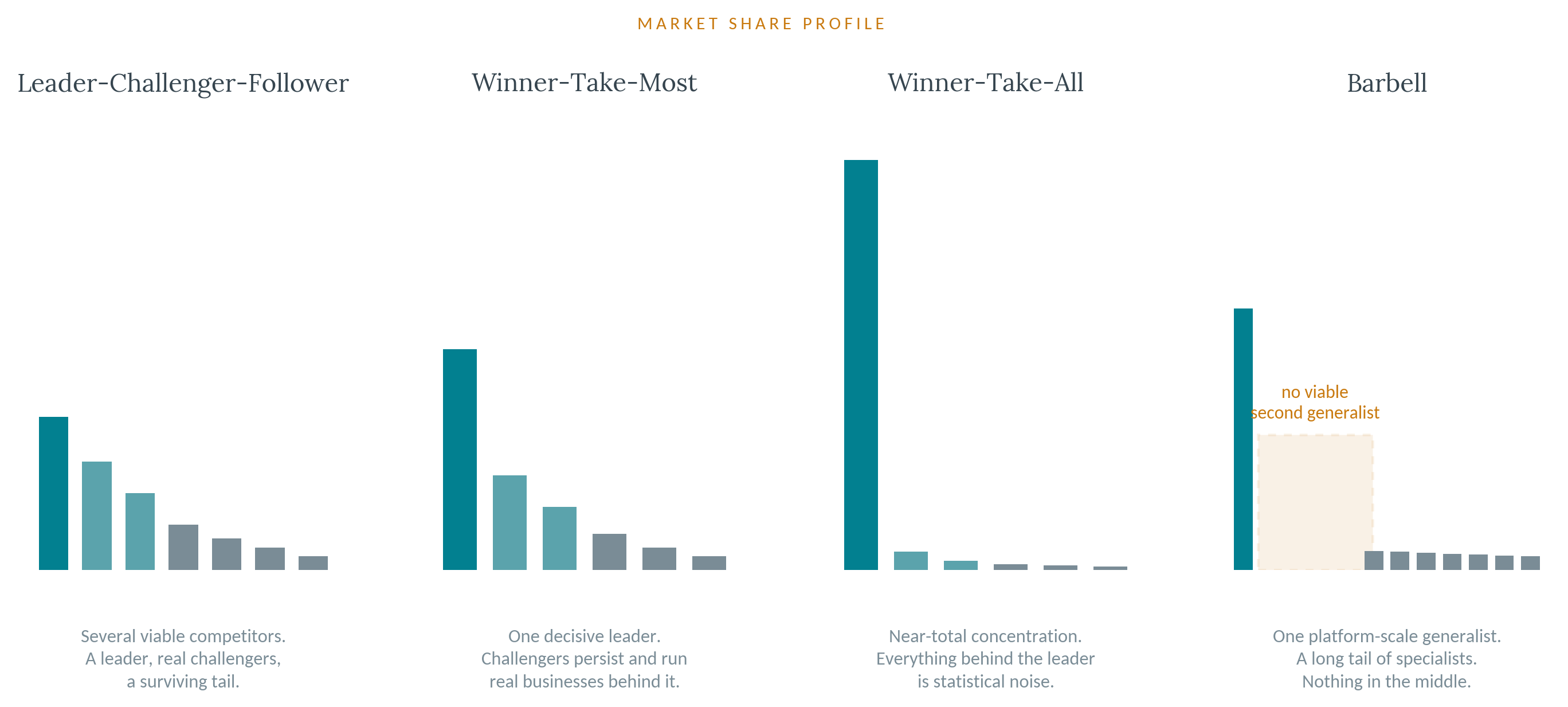
The proposal this essay tests is that these three structures map onto the five-stage diffusion curve in a specific, recurring order: Leader-Challenger-Follower at the infrastructure stage, Winner-Take-Most as access consolidates, Winner-Take-All at the applications stage, and a return toward Leader-Challenger-Follower, though, as the evidence below will show, not always a clean return, as the technology matures into services and cross-industry absorption.
III.
Why the Sequence Should Hold, Not Just That It Does
A pattern that merely correlates without an underlying mechanism is a coincidence waiting to break. Before testing the sequence against history, it is worth stating plainly why each stage should produce the structure predicted, because the mechanism is what would let this model generalize to markets not yet tested.
At the infrastructure stage, capital requirements are high, but the specific technical approach that will eventually dominate is still unsettled. Multiple well-capitalized players can survive simultaneously because no one has yet found the dominant design, and switching between infrastructure providers remains realistic before any single ecosystem has grown up around one of them. These conditions favor Leader-Challenger-Follower.
At the access stage, two forces begin to operate together. Network effects take hold, so the value of being on a given access network rises as more people join it. Switching costs climb at the same time, as customers accumulate the data, habits, and integrations tied to a specific provider. These are exactly the conditions economists associate with Winner-Take-Most: enough advantage to produce a clear leader, but not yet enough to eliminate real alternatives.
At the applications stage, network effects and switching costs typically peak together. Data accumulation, behavioral lock-in, and platform effects compound simultaneously, which is the condition most reliably associated with Winner-Take-All. This is also, not coincidentally, the stage that produces the largest individual fortunes and the most sustained regulatory scrutiny.
At the services and cross-industry stage, the technology that won the applications stage has itself become infrastructure-like: commoditized in its own right, extended into other industries. Competitive advantage shifts from platform scale toward vertical specialization and domain expertise. Those conditions favor fragmentation and a return toward something like Leader-Challenger-Follower, though the tested cases below show the return is not always clean.
IV.
Three Tests Against History
The real test of this model is not whether it sounds plausible. It is whether it predicts the documented market-share history of technologies whose outcomes are already known, checked stage by stage, not asserted from the outcome backward.
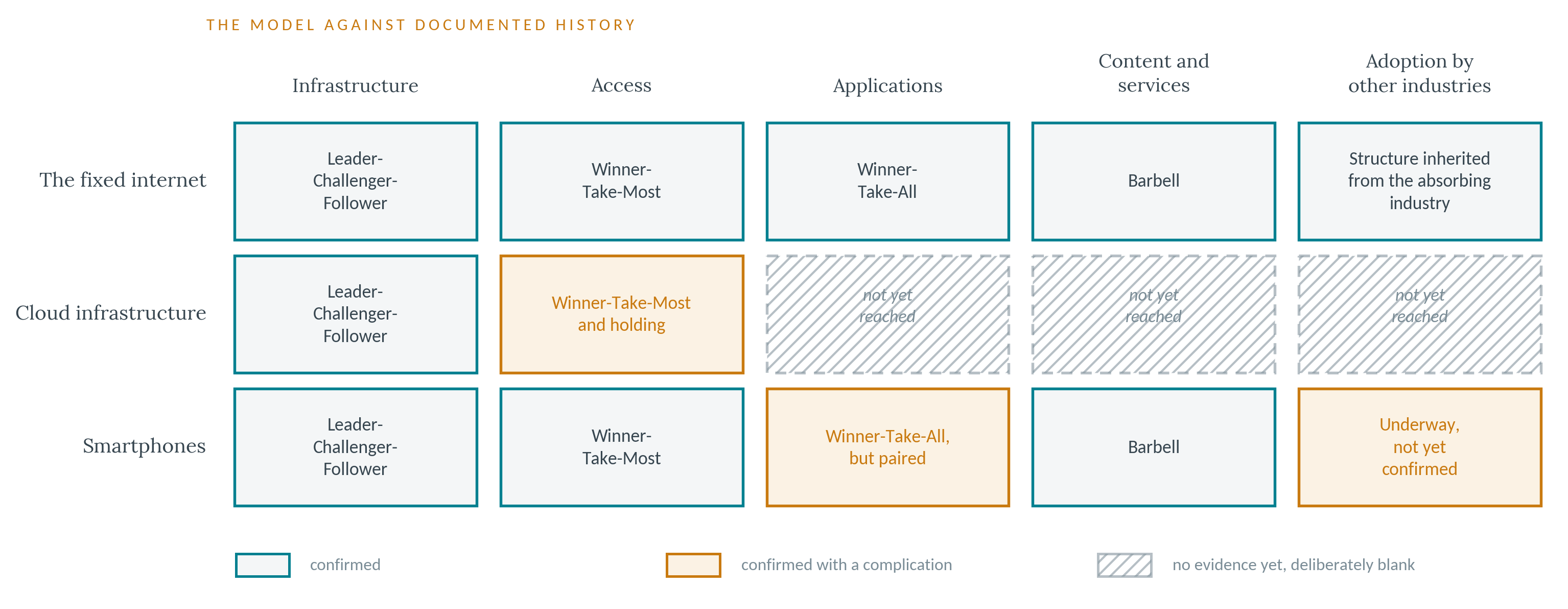
The fixed internet (1995–2010). The infrastructure stage, backbone providers building out the network itself, was genuinely Leader-Challenger-Follower: AT&T, MCI, Sprint, WorldCom, UUNET, and GTE all operated as real, competing infrastructure providers through the mid-1990s, with the stage eventually resolving through acquisition-driven consolidation rather than organic competitive victory. The access stage confirms Winner-Take-Most with unusual precision: AOL reached roughly half the dial-up market at its peak, while EarthLink, MSN, Excite@Home, and Prodigy each retained millions of subscribers, a clear leader, but no elimination of real alternatives. The applications stage confirms Winner-Take-All dramatically: search concentrated around a single provider commanding more than ninety percent of global share, sustained for over two decades, exactly the network-effect-and-switching-cost compounding the model predicts. The services and cross-industry stage confirms the predicted direction: fragmentation into a genuinely diverse retail and commerce landscape, from large horizontal players to specialized vertical marketplaces. There is a real complication, though. What emerged looks less like a clean three-player Leader-Challenger-Follower structure and more like one dominant generalist coexisting with a long tail of specialists, a barbell rather than a return to the original shape.
Cloud infrastructure (2006–present). The infrastructure stage again confirms Leader-Challenger-Follower cleanly: a first mover in 2006 was followed within several years by genuine, well-capitalized competitors, and a longer tail of regional and specialized providers survived for years afterward. The stage has since moved toward Winner-Take-Most, with three large providers now controlling roughly two-thirds of global spending, one clearly ahead but the other two commanding real, growing positions rather than token shares. What makes this case valuable is what it does not yet show: concentration has been rising steadily for a decade without resolving into Winner-Take-All, and enterprise buyers appear to be deliberately sustaining a multi-provider market through active multi-cloud strategies specifically designed to avoid the lock-in that would otherwise produce further concentration. This is either a stage not yet reached, or a genuine boundary condition, a market where customer behavior actively resists the model’s predicted endpoint. Either way, it is reported here as an open question rather than forced toward a tidy conclusion.
Smartphones (2000–present). The operating-system stage in 2003 and 2004 was unambiguously Leader-Challenger-Follower: Palm OS led without dominating, Symbian was closing on it as a genuine challenger, and Windows Mobile and BlackBerry OS held real if declining positions behind them. By the first quarter of 2006 that stage had already resolved into Winner-Take-Most, with Symbian near 60 percent and no rival above 13 percent, which is the transition the model predicts rather than an exception to it. Historical accounts of this period credit the underlying transition to a combination of enabling factors, Moore’s Law scaling of processors, improving battery chemistry, and steadily faster mobile data networks, the last of these sometimes attributed to a separate observation known as Edholm’s Law of Bandwidth. That law, proposed by Phil Edholm, a Nortel networking executive with no relation to this author, holds that wireless, nomadic, and wireline data rates each rise on parallel exponential curves, the slower catching the faster with a predictable lag. The coincidence of name is worth noting only because a reader tracing the smartphone case back to its sources is likely to run into it, a reminder that shared surnames occasionally produce shared footnotes without any shared authorship. The applications stage confirms Winner-Take-All, and does so with a useful refinement to the model: concentration arrived as a paired duopoly, two platforms together commanding well over ninety percent of app distribution, rather than the single-provider concentration seen in search. The most plausible explanation is that the hardware layer beneath the applications stage was itself already a duopoly by the time the applications stage matured, which may mean Winner-Take-All at the applications stage takes its specific shape, single winner or paired winners, from whatever structure already existed one layer down.
V.
What the Exceptions Teach
A model is more credible for what it admits it cannot yet explain than for what it confirms. Two real exceptions surfaced in testing, and both are more useful reported than smoothed over.
The fixed internet’s final stage did not return cleanly to Leader-Challenger-Follower. It produced a barbell, one dominant generalist and a long tail of thriving specialists, which suggests the model’s fourth stage may need a more precise label than simple reversion to the first stage’s structure. Fragmentation at maturity may not mean "several roughly equal competitors" so much as "one platform-scale winner alongside many small, defensible niches," which is a structurally different outcome worth naming on its own terms rather than forcing into the same category as the infrastructure stage’s genuine multi-way competition.
Cloud infrastructure has not yet, and may never, reach the Winner-Take-All concentration the model would predict at a later stage. If it does not, the reason is worth taking seriously as a limiting condition: where switching costs remain manageable and customers have strong, active incentives to preserve optionality, a market may stabilize at Winner-Take-Most indefinitely rather than proceeding further. That would mean the model’s stages describe a tendency under typical conditions, not an inevitability under all conditions, a more modest and more defensible claim.
VI.
What This Is Not Yet Tested Against
This essay deliberately does not test the model against artificial intelligence, and that omission is itself a decision worth explaining rather than an oversight to note in passing. AI’s competitive structure is still actively forming at every layer, from infrastructure to model provision to applications. Reaching for a verdict now would repeat precisely the error this series has warned against elsewhere: producing a confident conclusion because the moment invites one, not because the evidence yet supports it. The clearer position is to state the hypothesis the model would generate, then wait for enough history to check it properly, the same discipline applied to the three cases above. The hypothesis runs like this: AI infrastructure should currently resemble Leader-Challenger-Follower; a consolidation toward Winner-Take-Most should follow as access and distribution advantages compound; and the applications layer should eventually concentrate sharply, in either single-winner or paired form, depending on what has already consolidated one layer down.
VII.
Closing
Three independent technology markets, tested stage by stage rather than assumed from their outcomes, produce the same sequence with unusual consistency: competitive multiplicity while the technical approach is unsettled, consolidation as network effects and switching costs begin to compound, sharp concentration once they peak together, and a return toward fragmentation, though not always a clean one, once the winning layer has itself become infrastructure for what comes next.
This does not mean market structure is destiny, or that any given company’s position is foreordained by which stage its market currently occupies. It means something narrower and more useful: the question worth asking about any technology market is not only "who is winning," but "what stage is this, and what does that stage predict about how long the current structure will hold." A leader enjoying Winner-Take-Most dominance at the access stage should expect the ground to shift again as the market moves toward applications. A concentrated Winner-Take-All position at the applications stage should expect eventual fragmentation as the technology matures into services, even if that fragmentation arrives as a barbell rather than a clean return to open competition.
Whether this pattern holds for artificial intelligence is, at the time of writing, still an open question, and it should stay open until enough of AI’s own history has accumulated to check it properly, rather than closed early because everyone would like an answer now. That test belongs to a different piece of writing, once there is enough history to make it credible.
Mike Edholm has spent three decades advising corporations and institutions on strategy and scenario planning, with senior roles at Ericsson and IBM, and assignments spanning telecommunications, computing, industrial automation, and international development. This essay draws on Philip Kotler’s competitive-position taxonomy and the winner-take-all market analysis of Robert Frank and Philip Cook, tested against the documented market histories of the fixed internet, cloud infrastructure, and smartphones.